
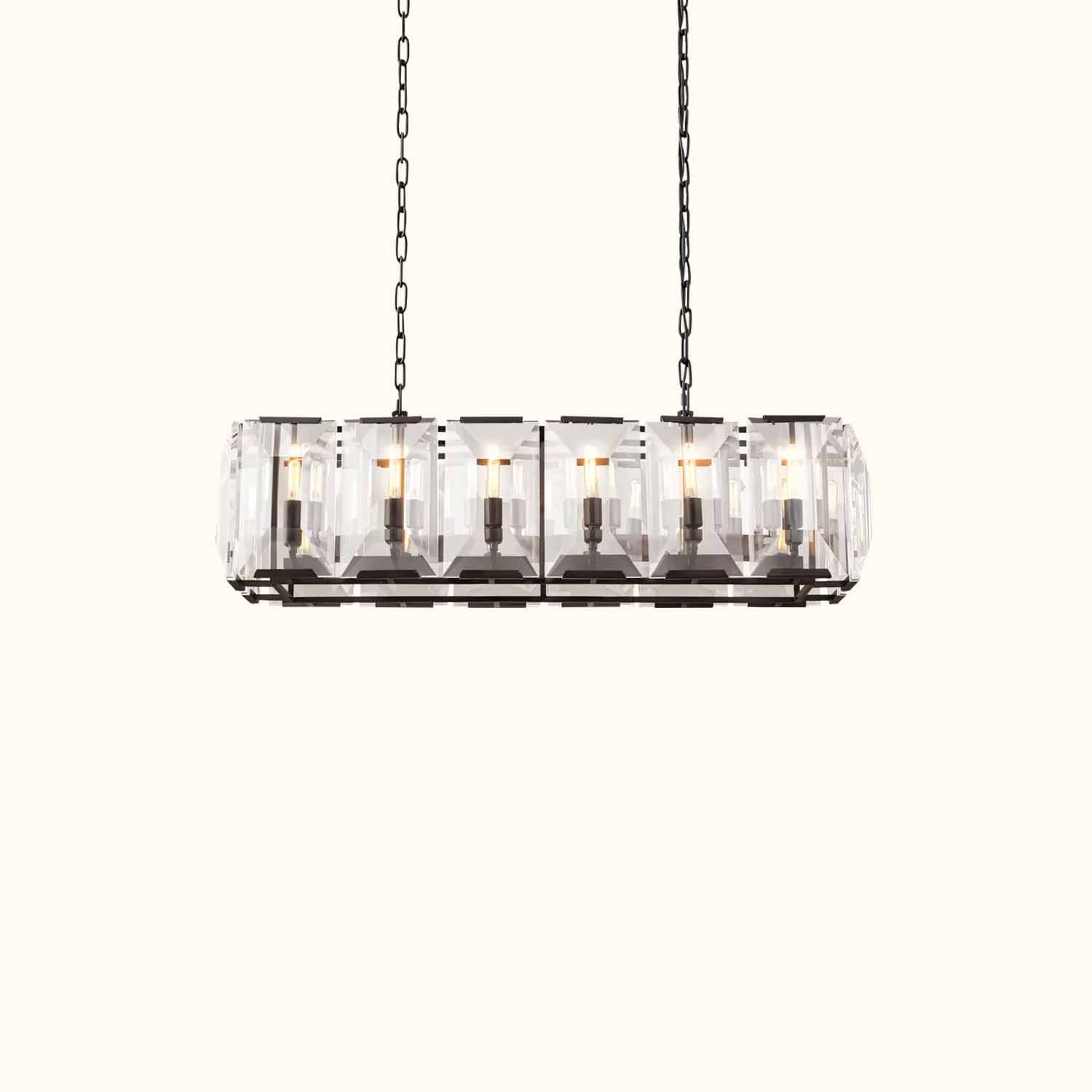
Choose a pendant or chandelier for a dining table by comparing the fixture’s footprint, the table shape and the complete hanging arrangement. One linear chandelier can form a single visual centre above a long table; several pendants can create a repeated rhythm. Neither approach guarantees suitable illumination from the product photograph alone.
Before choosing a model, draw the table, seating and ceiling connection points at the same scale. A fixture that looks balanced in a close-up photograph may appear too long, too narrow or visually heavy in the actual room. A measured plan helps buyers compare options before requesting samples.
Pendant lights or a chandelier: which layout fits the brief?
For this comparison, a pendant means an individual suspended light that can be used alone or repeated. A chandelier means a larger decorative assembly, such as a branched, round or linear fitting. Product categories can overlap, so compare the actual construction and dimensions rather than relying on the label.
| Layout | Useful design direction | Detail to resolve |
|---|---|---|
| One pendant | A single focal point above a compact or clearly defined table area. | Shade size, light distribution and the relationship to the table. |
| Several pendants | A repeated arrangement along a table or across several dining positions. | Number, centre-to-centre spacing, individual drops and ceiling connections. |
| Linear chandelier | One continuous decorative form aligned with a rectangular table. | Overall body width and depth, suspension positions and selected hanging height. |
| Round or branched chandelier | A central decorative form to compare with a round or square table. | Full arm or shade spread, visual balance and access for maintenance. |
Compare real fixture dimensions
HPL-001459 is a rectangular brass and glass chandelier. Its listed body sizes are 105, 137, 154 and 185cm wide, each with a 42cm depth and 30cm height. These body dimensions help establish its outline; the listed 30cm body height does not establish the total ceiling-to-bottom drop.
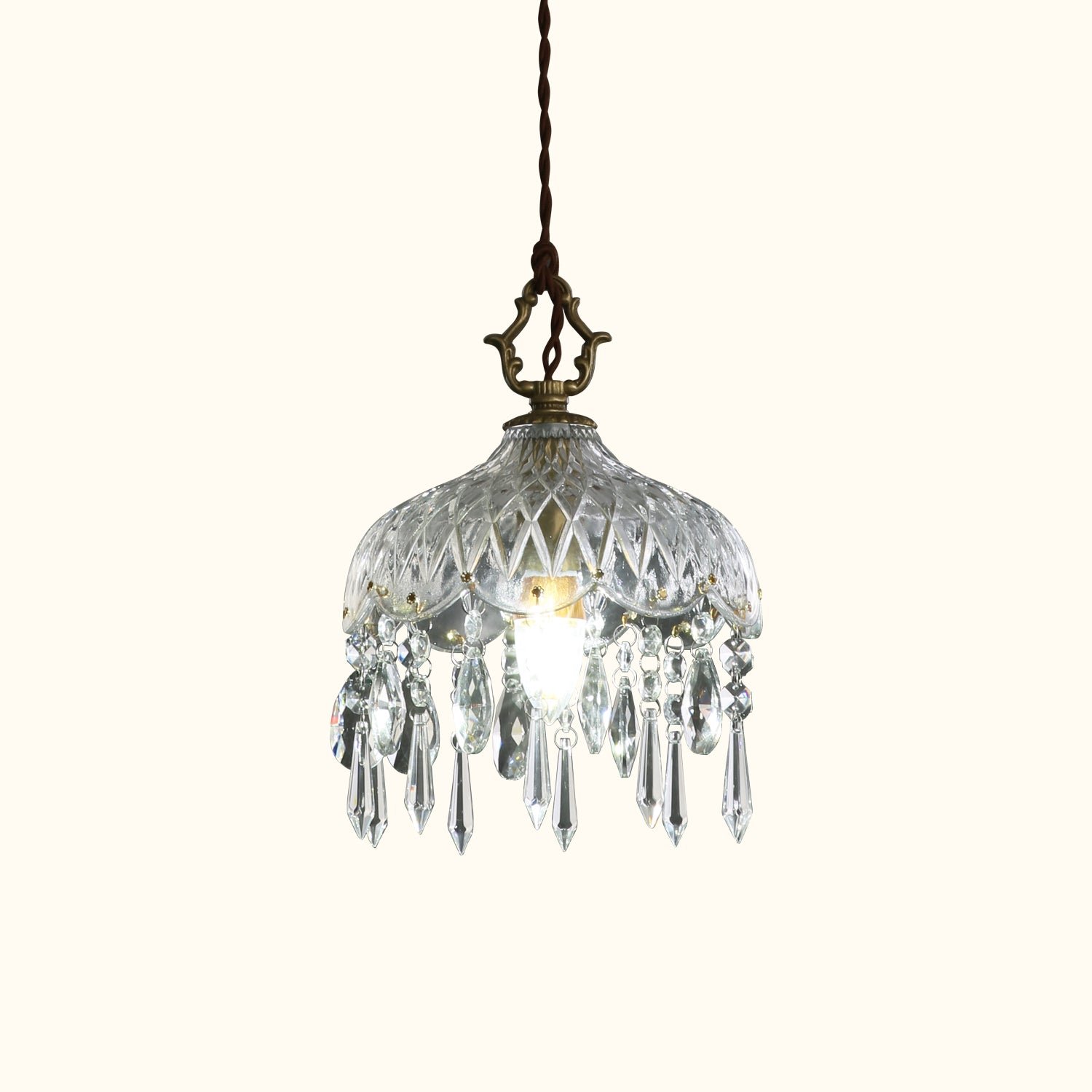
For a smaller repeated element, HPL-001453 lists a 20cm diameter and 25cm body height, with brass, glass and crystal materials and an E27 × 1 light-source field. Several units would require a separate layout showing their spacing and electrical connection arrangement.
A worked example for checking proportions
Suppose a drawing shows a 240cm-long, 100cm-wide table and the buyer is considering the 137cm-wide version of HPL-001459. Centring the fixture gives (240 − 137) ÷ 2 = 51.5cm of table length beyond each end. Across the table, (100 − 42) ÷ 2 = 29cm beyond each side of the fixture outline.
This calculation describes the plan-view relationship only. It is not a recommended clearance, a hanging-height rule or a lighting calculation. Use it to compare the outline on the drawing, then review the room elevations, sightlines and installation requirements with the project team.
Keep three hanging measurements separate
- Fixture body: the size of the decorative assembly itself.
- Suspension: the required rod, cable or chain arrangement and any adjustment range.
- Installed position: the final ceiling-to-bottom dimension coordinated with the table and room.
A useful enquiry includes the ceiling height, table dimensions, ceiling plan and a marked elevation. For a sloped ceiling or an existing ceiling outlet, identify that condition before the mounting arrangement is agreed. Do not scale installation dimensions from a lifestyle photograph.
Check illumination and controls separately from size
Ask for the selected lamp or LED specification, light output, colour temperature and control compatibility. A large decorative body does not by itself establish more useful light on the table. The U.S. Department of Energy explains that fixture design and optical control affect how light reaches the intended application.
If dimming is required, identify the intended control and the proposed light source together. A socket type or voltage range alone does not establish dimming compatibility. The existing decorative lighting specification checklist can help structure the electrical and ordering details.
Buyer questions
Should a chandelier always be a fixed fraction of the table length?
A ratio can be a sketching aid, but it cannot settle the choice alone. Compare the actual fixture footprint, seating, room volume, light distribution and hanging arrangement on the project drawings.
Can several pendants share one canopy?
That depends on the selected design and electrical construction. Include the proposed number, spacing and ceiling connection points in the enquiry so the arrangement can be reviewed.
Does the product’s body height include the chain or cable?
Do not assume so. Ask for a drawing that identifies the body, suspension and complete installed drop separately.
Compare dining-area lighting options
Browse pendant lights and chandeliers, then send the model references, table size, ceiling height, quantity and destination market. For a proposed layout change, include a marked drawing in your custom lighting brief.